FOXO4-DRI: What the Senescent-Cell Research Actually Shows
FOXO4-DRI is one of those compounds where the mouse data is genuinely striking and the human data doesn’t exist at all. That gap is the whole story, and it’s worth understanding properly — because the science behind it is clever, specific, and a lot more interesting than the marketing around it. Here’s what the research actually shows, where it came from, and what nobody can tell you yet.
First, the problem it was built to solve
Every cell in your body can divide only so many times. When a cell hits its limit, or takes enough damage to its DNA, it does something sensible: it stops dividing. That’s a safety feature. A damaged cell that keeps dividing is how tumours start, so switching it off permanently is the body protecting itself.
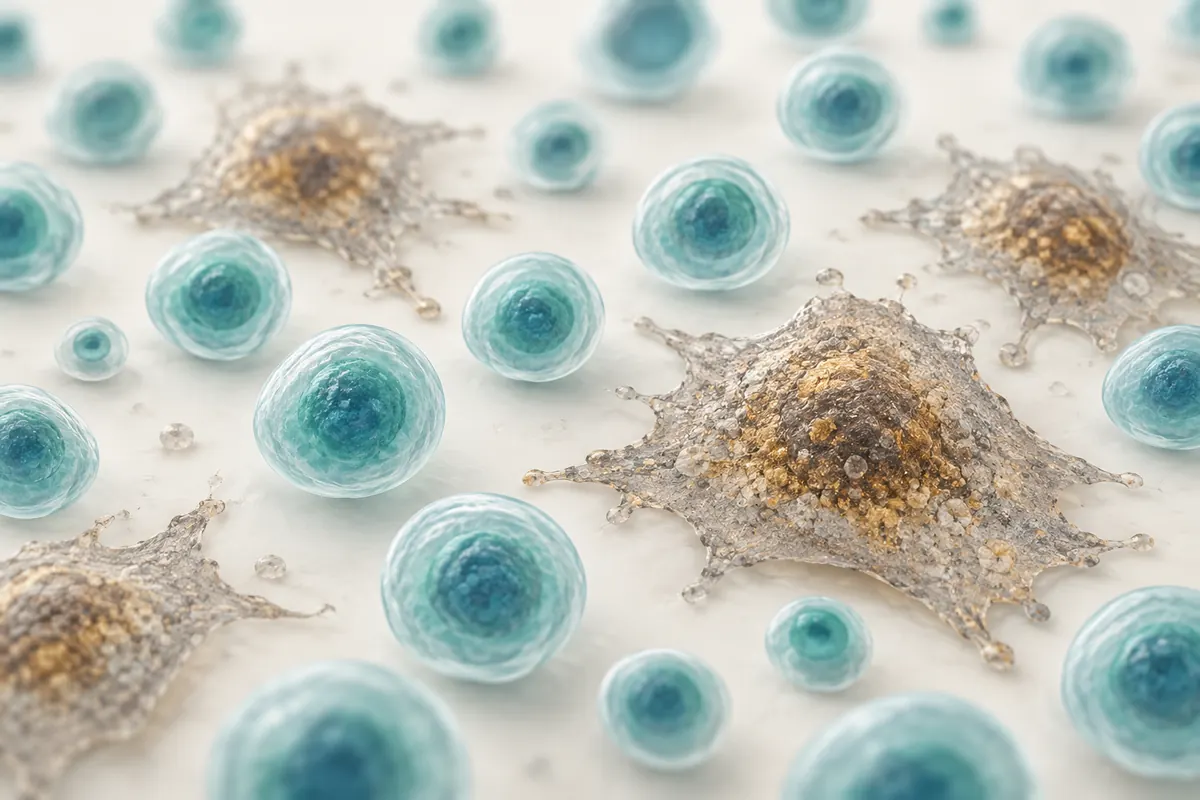
The trouble is what happens next. These retired cells — called senescent cells — don’t quietly disappear. They sit there, and they talk. They pump out a steady stream of inflammatory signals, growth factors and enzymes that chew through surrounding tissue. Researchers call this the senescence-associated secretory phenotype, or SASP, which is a very long name for “these cells make a mess of the neighbourhood”.
A handful of them is fine. Your immune system clears them. But they accumulate — with age, after radiation, and especially after chemotherapy, which damages healthy cells alongside cancerous ones. Eventually they’re being created faster than they’re cleared, and the low-grade inflammation they produce starts showing up as the things we associate with getting old: stiffer joints, slower healing, tissue that doesn’t bounce back.
The idea that these cells are a cause rather than a symptom came from mouse studies where researchers genetically removed senescent cells and the animals simply did better — healthier for longer. That finding kicked off the hunt for drugs that could do the same thing chemically. The field calls them senolytics: compounds that kill senescent cells while leaving healthy ones alone.
The survival trick FOXO4-DRI was designed to break
Here’s the part that makes this compound interesting rather than just another entry on a list.
Senescent cells are, in a sense, already primed to die. Researchers found that inside them, the pro-death machinery is switched up and the anti-death machinery is switched down. The cell is sitting on the trigger. Something is holding it back.
That something involves a protein you may have heard of: p53, often called the guardian of the genome. One of p53’s jobs is to order a badly damaged cell to self-destruct. In senescent cells, a transcription factor called FOXO4 grabs hold of p53 and keeps it penned up in the nucleus, where it can’t give that order. The senescent cell survives on a technicality.
FOXO4-DRI is a short peptide built to break that specific grip. It mimics the part of FOXO4 that latches onto p53, so it competes for the same spot. When it wins, p53 is released, leaves the nucleus, heads for the mitochondria, and sets off the cell’s own demolition sequence — cytochrome c release, BAX and BAK activation, caspase-3 doing the actual work.
Healthy cells aren’t sitting on that trigger in the first place, which is where the selectivity comes from. Take the brake off a cell that isn’t straining against it and not much happens.
What the “DRI” actually means
This is the bit of engineering that makes the thing work at all, and it’s genuinely neat.
Peptides are chains of amino acids, and your body is extremely good at taking them apart. The enzymes that do this are shaped to recognise the natural form of amino acids, called the L-form. Feed them an ordinary peptide and it’s dismantled quickly.
D-Retro-Inverso is a workaround. Build the chain out of mirror-image D-form amino acids instead, then reverse the order of the sequence. Two inversions that cancel each other out: the side chains end up sitting in roughly the same positions in space, so the peptide still fits p53 the way the original did — but the enzymes looking for an L-form chain to chew on don’t recognise it. Same shape where it matters, far harder to digest.
The landmark study
Nearly everything known about this compound traces back to one paper: Baar and colleagues, published in Cell in 2017. It’s worth being precise about what it found, because this is the study everything else leans on.
In the dish. Against human lung fibroblasts, FOXO4-DRI reduced the viability of senescent cells 11.73 times more potently than non-senescent controls from the same cell line. Not a vague “selective” — a measured ratio, in a matched comparison.
After chemotherapy. Mice given doxorubicin, a chemotherapy drug that leaves a trail of senescent cells behind it, developed liver damage and lost condition. Treated with FOXO4-DRI, they kept their body weight and their markers of liver injury came down.
In old mice. Naturally aged animals showed more spontaneous activity on a running wheel, better fur density, and improved kidney function.
In fast-ageing mice. The same held in a progeroid strain engineered to age rapidly — a harder test, because these animals accumulate senescent cells on fast-forward.
One detail matters for interpreting all of it: the peptide was given intermittently, not continuously. The logic is that you clear the backlog and stop, rather than suppressing something permanently.
What came after
Since 2017 the work has spread into specific tissues, and the pattern has largely held.
Cartilage. When human chondrocytes — the cells that build cartilage — are grown in the lab for transplant research, a fraction of them turn senescent and drag down the quality of the batch. A 2021 study in Frontiers in Bioengineering and Biotechnology found FOXO4-DRI stripped the senescent ones out of expanded cultures while leaving the rest working. If you’ve read our rundown of peptides in arthritis research, this is a different angle on the same problem — improving the cells before they go anywhere near a joint.
Testicular tissue. Two groups have looked at Leydig cells, which produce testosterone and accumulate senescence with age. A 2020 paper in Aging reported that clearing senescent Leydig cells improved the testicular environment in aged mice and lifted testosterone. A 2024 follow-up in Experimental Gerontology reported improved sperm quality in aged mice, crediting reduced SASP output from those cells. Both are mouse work. For context on how hormone questions get studied rather than guessed at, our piece on testosterone research in women covers similar ground.
Structure. In July 2025, a team published solution structures of p53 bound to FOXO4 and to FOXO4-DRI in Nature Communications. They found the two partners form a loose, transiently folded complex rather than a rigid lock-and-key fit, and that phosphorylating p53 — which happens under stress — strengthens its grip on both FOXO4 and the peptide. Eight years on, that’s the first proper structural picture of why the thing binds where it does.
The cancer question, answered honestly
It’s a reasonable thing to ask about anything that interferes with p53, given p53’s day job is stopping tumours.
The mechanism argues the right way: FOXO4-DRI releases p53 to do its work rather than blocking it, and in the chemotherapy models the original authors saw no sign of tumour promotion. A wrinkle worth knowing: many cancer cells carry mutated or inactive p53, so there may be nothing for the peptide to release in those cells — which cuts against it being useful as a cancer treatment rather than suggesting it’s dangerous. Whether clearing senescent cells changes the environment around a tumour, for better or worse, is still an open research question.
What nobody can tell you
This is the part that should carry the most weight, and it’s short.
There are no human trials. Not ongoing ones, not completed ones. As of 2026, ClinicalTrials.gov returns nothing for this compound, and no human pharmacokinetic, safety or efficacy data has been published. Everything above happened in cell cultures and rodents.
That means the following are simply unknown: how it behaves in a human body, what dose would do anything, how often, how long it stays intact, whether the immune system reacts to a mirror-image peptide, what repeatedly clearing senescent cells does over years, and whether interfering with FOXO proteins — which have other jobs, including in metabolism and stress response — causes problems elsewhere.
Anyone quoting you a human protocol for FOXO4-DRI is extrapolating from mice. The honest answer is that the translation step hasn’t been attempted.
Where that leaves it
FOXO4-DRI is a well-designed tool built on a genuinely clever insight: find the specific crutch senescent cells lean on, kick it away, and let the cell finish what it already started. The preclinical results are consistent across several labs and several tissues, which is more than many compounds in this space can say.
It is also, strictly, a research compound — and the distance between “works beautifully in aged mice” and “works in people” is where most promising molecules stop. The FOXO4 peptide we stock is supplied for laboratory research use only, and like every lyophilised peptide it’s sensitive to how it’s handled; our guide to storing peptides properly covers reconstitution and cold chain, which matter more than people expect for a compound whose whole selling point is structural stability.
If the field does take this one into humans, we’ll cover what the trials find — including if the answer is disappointing.
This article is for research and educational purposes. Products referenced are supplied for laboratory research use only and are not for human or veterinary use. Nothing here is medical advice or a dosing protocol.