Selank vs Semax: Together or Separate?
Semax and Selank are two peptides developed in Russia and usually talked about as a pair: one for focus, one for calm. They come from completely different parents — Semax from a stress hormone, Selank from an antibody — but they were built the same way, in the same lab, and both are sold as nasal sprays. Here is what each one is, what the research shows, how people use them, and what the studies have and haven't covered.
Where they came from
Both peptides were made at the Institute of Molecular Genetics of the Russian Academy of Sciences in Moscow, working with Moscow State University. Igor Ashmarin and Nikolai Myasoedov are the names attached to the programme.
Semax is a chain of seven amino acids: Met-Glu-His-Phe-Pro-Gly-Pro. The first four come from ACTH, the hormone that tells the adrenal gland to release cortisol. The rest of ACTH is not there. The part that actually switches the adrenal gland on is missing, so Semax does not act as a hormone.
Selank is also seven amino acids: Thr-Lys-Pro-Arg-Pro-Gly-Pro. The first four are tuftsin, a natural peptide first described in Nature in 1970 and named after Tufts University. Tuftsin is cut out of an antibody by enzymes, and its normal job is in the immune system.
The shared part is the tail on the end of both, Pro-Gly-Pro. It was added to slow the body's enzymes down so the peptide lasts longer. Both are licensed medicines in Russia, sold as nasal drops.
What Semax does
Most of the interest in Semax is about BDNF, a growth factor the brain uses to build and maintain connections.
In rats, a single nasal dose raised BDNF protein in the hippocampus by about 1.4 times and increased signalling at its receptor by about 1.6 times. A follow-up study tracked the timing and found it moves around. Twenty minutes after a dose, BDNF had gone down in the hippocampus and up in the frontal cortex. Both were back to normal at 40 minutes, then rising again at 90 minutes. It reads less like turning a dial up and more like nudging a system.
Dopamine is often mentioned too, and the detail is worth knowing. In rats, Semax on its own did not change dopamine levels. It only made a difference when given before a stimulant, where it increased the dopamine response.
In people, two small studies scanned the brains of healthy volunteers before and after a dose. Connectivity between brain networks changed within 5 to 20 minutes. That is a fast, measurable biological effect. Those studies did not test memory, attention or mood, so they show something happens rather than what it feels like.
What Selank does
Selank is an anxiolytic, and it works with the GABA system, the brain's main calming signal. How it does that is the interesting part.
Selank has never been shown to sit on the GABA-A receptor itself the way a benzodiazepine does. In rat brain tissue it behaves as a positive modulator, and in rat brain slices it increases the brain's own inhibitory activity. In other words, it seems to work with the existing signal rather than forcing the channel open.
The gene work shows how much it depends on context. In rats, a single nasal dose changed 29 of the 77 genes measured in the frontal cortex within an hour — but 25 of those were genes GABA moves anyway. In human cells in a dish, Selank on its own changed nothing; it only changed what GABA did.
The route also matters. In mice given the same dose for five days, injected Selank raised GABA binding sites in the frontal cortex by 38%, while nasal Selank left GABA alone and raised NMDA sites by 23% instead. Same peptide, same dose, different result depending on how it went in.
It also kept its immune background. One dose changed the activity of 34 of 84 inflammation-related genes in mouse spleen. And in mice, it reduced anxiety across a wide dose range without the sedation you would expect from a tranquilliser at the top of that range.
Why people pair them
The logic is simple enough. Semax is studied for drive and clarity and acts quickly. Selank is studied for anxiety and does it without sedating. Put together, the idea is that one provides the push and the other takes the edge off it.
Worth knowing: that pairing has not been studied. No published research, in people or animals, has given the two together. Fourteen papers mention both peptides, and every one of them tests them separately. The combination comes from putting their two profiles side by side, not from a trial of the pair.
What the human studies show
Semax. The human work is mostly Russian and mostly in stroke. A 1997 study compared 30 treated patients with 80 on standard care. A 2018 study in 110 patients after stroke reported that BDNF in the blood went up, though it published no figures. In 27 patients with motor neurone disease, nasal Semax did not change the nerve test results or the clinical scores. The only placebo-controlled human studies are the two brain scans, in 24 and 52 volunteers.
Selank. There are five human studies, all Russian. A 2008 study in 62 people with generalised anxiety and neurasthenia compared it against the benzodiazepine medazepam and rated the two comparable. A 2014 study in 60 people compared it against phenazepam. The benzodiazepine reduced anxiety more during the two weeks of treatment, 55% against 26.3%. A week after both were stopped, Selank was ahead.
The most useful result is the third. A 2015 study added Selank to phenazepam in 70 patients. It did not significantly improve the response rate at two weeks, but it roughly halved the benzodiazepine's effect on cognitive test scores. Side effects were formally rated in these trials. On phenazepam the notable ones were sedation, fatigue and emotional flatness. On Selank the main complaint was a dry nose.
Russia's approved product information for Selank describes nasal drops at 1.5 mg/mL, 900 to 2,700 micrograms a day split across three doses, for a course of 10 to 14 days. Neither peptide has been through a trial outside Russia.
What people report
The pattern described in user communities is fairly consistent. Semax is described as clear-headed focus, used in the morning, with some people saying it affects their sleep if taken late in the day. Selank is described as subtle. It takes the background tension away rather than producing a noticeable effect, and some people say they do not feel it at all.
One of those reports has a published counterpart. In the Russian trial against medazepam, 3 of the 22 patients on Selank had increased anxiety, irritability, insomnia and raised blood pressure. The investigators put it down to too much stimulation: two patients stopped and one continued on a lower dose, where the effects settled. Their advice was not to dose late in the day in people who are prone to insomnia. Insomnia after Semax has not been reported in any published study, so that one remains a user observation.
How people take them
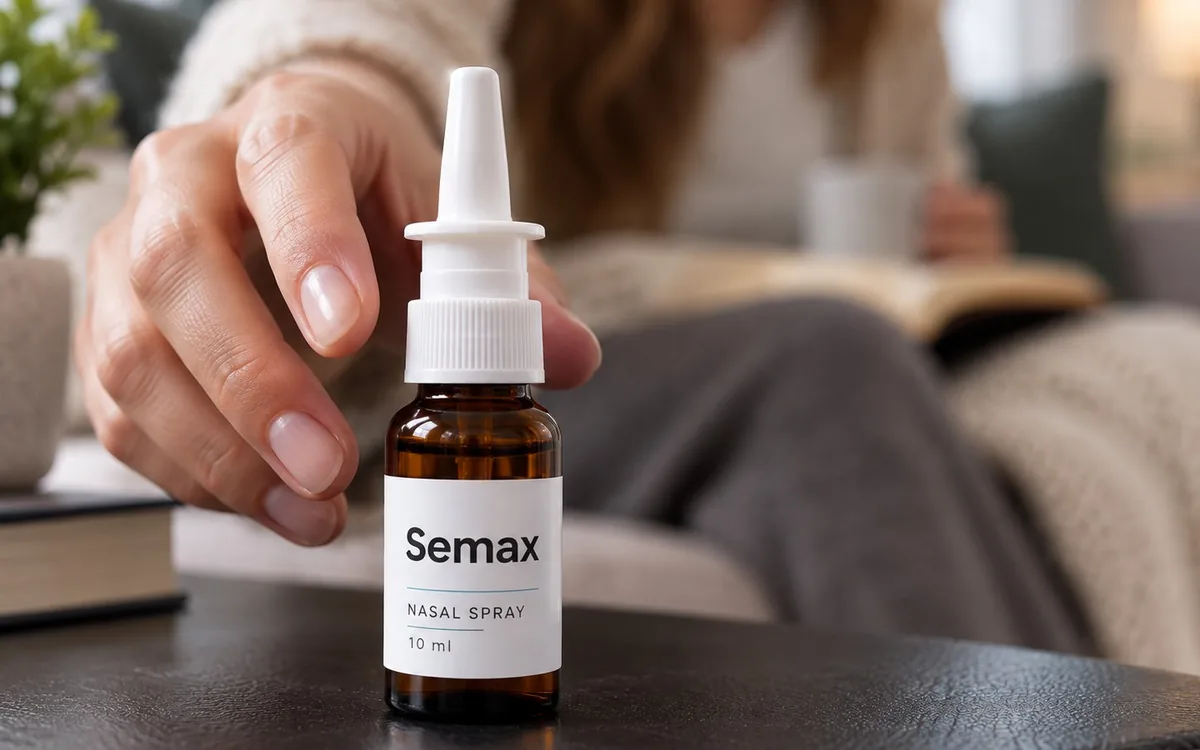
In Russia both are sold as nasal drops. Online they are usually sold as a dry powder to be mixed, then used either in a nasal spray or injected under the skin.
Nasal or injected. No human study has compared the two routes for either peptide. The mouse study above is the reason to take that seriously: the route changed which receptor system responded, so a nasal protocol and an injected one are not the same thing. Nasal delivery to the brain has been shown directly in rats, where tracer studies found the peptide in brain tissue two minutes after a nasal dose, about 80% of it still intact.
What to mix them with. The choice of liquid is about keeping the vial sterile and the peptide stable:
- Bacteriostatic water is sterile water with 0.9% benzyl alcohol added as a preservative. That preservative is what allows a vial to be used more than once. Standard practice is to date it when first punctured and discard it after 28 days.
- Sterile water and plain saline have no preservative, so they are single-use.
- Phosphate-buffered saline and dilute acetic acid are used where the peptide needs help dissolving or the pH needs holding steady.
For nasal use, it helps to know how the licensed products are made. Approved nasal peptide sprays such as calcitonin and desmopressin use benzalkonium chloride or chlorobutanol as their preservative, not benzyl alcohol. The most benzyl alcohol the FDA has accepted in a metered nasal spray is about half the concentration in bacteriostatic water. That is why plain saline is the usual choice for a nasal mix, and bacteriostatic water for an injected one.
Handling. Swirl the vial gently rather than shaking it. Keep it cold and out of the light, and avoid repeated freezing and thawing. In peptide handling studies, heat, freeze-thaw cycles and vigorous shaking are the main things that damage the product. Check the solution for particles before use. If you use a nasal spray, keep it to one person: in one study, 18 of 20 shared nasal spray bottles grew bacteria after three days of use, against 3 of 20 used as drops.
Other things people take. There is no published interaction data for either peptide with antidepressants or stimulants in people. The one relevant finding is the rat study mentioned earlier, where Semax given before a stimulant increased the dopamine response. That is useful context for anyone already taking one.
Where they stand
Both are registered medicines in Russia — Semax as 0.1% and 1% nasal drops, Selank as nasal drops for anxiety. Neither is approved in the United States, Europe or Australia, and neither has a registered clinical trial outside Russia. The FDA reviewed Semax in 2026 and found the evidence insufficient for the uses that had been proposed for it.
In Australia, neither peptide appears in the current Poisons Standard. That is a difference from peptides like BPC-157, TB-500, CJC-1295 and ipamorelin, which are all listed. Neither is named on the 2026 WADA prohibited list either. That list also covers substances with a similar structure or effect, so competing athletes should check with their own anti-doping body.
The short version
- Semax is an ACTH fragment studied for focus and recovery. The mechanism work is mostly in rats and centres on BDNF. The human studies are Russian and mostly in stroke. It acts within minutes, not days.
- Selank is a tuftsin fragment studied for anxiety. It works with the GABA system indirectly, and in the trials it reduced anxiety without the sedation that came with the benzodiazepine it was compared against.
- Together is an untested idea built from two tested-separately profiles. It is a reasonable hypothesis, and that is all it is at this stage.
- Both are nasal-first, both act quickly, and both have a research base that is almost entirely Russian.
References
- Najjar VA, Nishioka K. “Tuftsin”: a natural phagocytosis stimulating peptide. Nature. 1970;228(5272):672–673. View study
- Dolotov OV, Karpenko EA, Inozemtseva LS, et al. Semax, an analog of ACTH(4-10) with cognitive effects, regulates BDNF and trkB expression in the rat hippocampus. Brain Res. 2006;1117(1):54–60. View study
- Agapova TIu, Agniullin IaV, Silachev DN, et al. Effect of semax on the temporary dynamics of brain-derived neurotrophic factor and nerve growth factor expression in the rat hippocampus and frontal cortex. Mol Gen Mikrobiol Virusol. 2008;(3):28–32. View study
- Eremin KO, Kudrin VS, Saransaari P, et al. Semax, an ACTH(4-10) analogue with nootropic properties, activates dopaminergic and serotoninergic brain systems in rodents. Neurochem Res. 2005;30(12):1493–1500. View study
- Volkova A, Shadrina M, Kolomin T, et al. Selank administration affects the expression of some genes involved in GABAergic neurotransmission. Front Pharmacol. 2016;7:31. View study
- Vasil'eva EV, Kondrakhin EA, Salimov RM, Kovalev GI. Comparison of pharmacological effects of heptapeptide Selank after intranasal and intraperitoneal administration. Eksp Klin Farmakol. 2016;79(10):3–10. View study
- Kolomin T, Shadrina M, Andreeva L, et al. Expression of inflammation-related genes in mouse spleen under tuftsin analog Selank. Regul Pept. 2011;170(1–3):18–23. View study
- Seredenin SB, Kozlovskaia MM, Blednov IuA, et al. The anxiolytic action of an analog of the endogenous peptide tuftsin on inbred mice with different phenotypes of the emotional stress reaction. Zh Vyssh Nerv Deiat Im I P Pavlova. 1998;48(1):153–160. View study
- Gusev EI, Skvortsova VI, Miasoedov NF, et al. Effectiveness of semax in acute period of hemispheric ischemic stroke. Zh Nevrol Psikhiatr Im S S Korsakova. 1997;97(6):26–34. View study
- Gusev EI, Martynov MY, Kostenko EV, et al. The efficacy of semax in the treatment of patients at different stages of ischemic stroke. Zh Nevrol Psikhiatr Im S S Korsakova. 2018;118(3 Vyp 2):61–68. View study
- Serdiuk AV, Levitskii GN, Miasoedov NF, Skvortsova VI. The study of chronic partial denervation and quality of life in patients with motor neuron disease treated with Semax. Zh Nevrol Psikhiatr Im S S Korsakova. 2007;107(4):29–39. View study
- Lebedeva IS, Panikratova YR, Sokolov OY, et al. Effects of Semax on the default mode network of the brain. Bull Exp Biol Med. 2018;165(5):653–656. View study
- Panikratova YR, Lebedeva IS, Sokolov OY, et al. Functional connectomic approach to studying Selank and Semax effects. Dokl Biol Sci. 2020;490(1):9–11. View study
- Zozulia AA, Neznamov GG, Siuniakov TS, et al. Efficacy and possible mechanisms of action of a new peptide anxiolytic selank in the therapy of generalized anxiety disorders and neurasthenia. Zh Nevrol Psikhiatr Im S S Korsakova. 2008;108(4):38–48. View study
- Medvedev VE, Tereshchenko ON, Israelian AIu, et al. A comparison of the anxiolytic effect and tolerability of selank and phenazepam in the treatment of anxiety disorders. Zh Nevrol Psikhiatr Im S S Korsakova. 2014;114(7):17–22. View study
- Medvedev VE, Tereshchenko ON, Kost NV, et al. Optimization of the treatment of anxiety disorders with selank. Zh Nevrol Psikhiatr Im S S Korsakova. 2015;115(6):33–40. View study
- Shevchenko KV, Nagaev IIu, Alfeeva LIu, et al. Kinetics of Semax penetration into the brain and blood of rats after its intranasal administration. Bioorg Khim. 2006;32(1):64–70. View study
- Brook I. Bacterial contamination of saline nasal spray/drop solution in patients with respiratory tract infection. Am J Infect Control. 2002;30(4):246–247. View study
- Behi J, Hassiki R, Ben Said N, et al. Apparent degradation forms of rhG-CSF under forced conditions. Anal Biochem. 2019;586:113440. View study
- Therapeutic Goods (Poisons Standard—June 2026) Instrument 2026 (Cth), F2026L00633, in force 28 May 2026. View instrument